When a family inherits a house, keeping it as a rental can seem appealing, especially when the property has been owned for many years.
But an inherited home is not automatically a suitable rental investment.
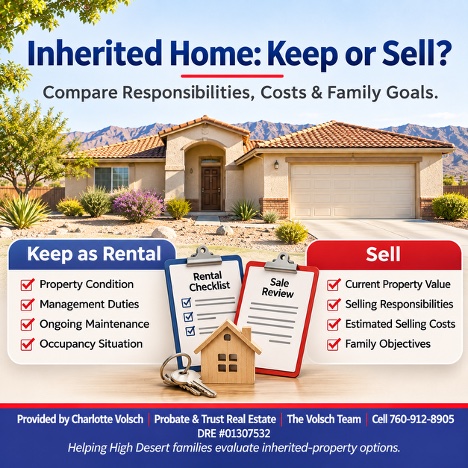
Before keeping an inherited property as a rental in the High Desert of Southern California, heirs should evaluate its physical condition, occupancy status, ongoing management responsibilities, projected ownership costs, family objectives, and the financial implications of selling.
I encourage families to examine six questions.
1. Is the property ready for rental occupancy?
Review the roof, heating and cooling, plumbing, electrical systems, safety conditions, and deferred maintenance.
Determine what inspections, repairs, and compliance work may be necessary before offering the property for rent.
2. Who will manage the property?
Rental ownership involves tenant screening, rent collection, repairs, maintenance coordination, recordkeeping, and compliance with applicable landlord-tenant requirements.
Heirs should decide whether they have the capacity to manage these duties or need professional property management.
3. What is the property’s occupancy situation?
An inherited property may be vacant, occupied by a tenant, or occupied by a family member.
Existing leases, possession rights, and occupancy arrangements require careful review before decisions are made.
4. What will ownership actually cost?
A rental evaluation should include documented estimates for:
· Property taxes and insurance.
· Repairs and maintenance.
· Property management.
· Vacancy and turnover.
· Utilities and other owner-paid expenses.
· Capital improvements and replacement reserves.
Potential rental income should be evaluated alongside these expenses, not in isolation.
5. Do the heirs share the same objectives?
Some family members may prefer recurring rental income. Others may want liquidity, fewer responsibilities, or a completed estate distribution.
Ownership structure, decision authority, and estate obligations should be clarified with the appropriate legal and tax professionals.
6. What would selling provide instead?
Compare the rental scenario with a current property valuation, estimated selling expenses, projected net proceeds, and the family’s long-term objectives.
A rental projection and a sale estimate should use clearly stated assumptions.
In High Desert communities such as Apple Valley, Victorville, and Hesperia, inherited-property decisions should reflect the specific home, not broad assumptions about rental demand or appreciation.
Through more than 230 probate and trust property sales, I have seen how important it is for families to distinguish emotional attachment from practical ownership responsibilities.
The central question is not simply whether the home can generate rent. It is whether continued ownership makes sense for the property, the estate, and the people responsible for it.
For families inheriting property in the High Desert of Southern California, which issue would be most important in deciding whether to rent or sell: management responsibilities, repair costs, family agreement, or financial flexibility?
Charlotte Volsch | Estate Property Advisor & Probate & Trust Real Estate Specialist | 230+ Estate Property Sales | The Volsch Team at Volsch Enterprises, Inc. | 760-912-8905
#HighDesertRealEstate #InheritedProperty #EstatePlanning #RentalPropertyDecisions #ProbateRealEstate