What Do Title and Escrow Companies Do?

1. Once a buyer and seller come to an agreement, paperwork becomes the driving force that moves the process along. When the purchase of a home involves a bank or lender to partially finance the purchase, the title and escrow companies coordinate all the documentation. Escrow companies have the responsibility of administering the agreed upon terms of a purchase agreement and securing whatever funds and documents involved in the transaction until the sale is complete.
2. The escrow account handles monies or documents once a home has been sold. This includes the actual cost of the home, title and escrow companies’ services, as well as fees charged by the lender. The escrow account holds these payments until the terms of the purchase agreement have been fulfilled. The escrow company protects the interests of buyers, sellers, and the lending institution.
3. Steps are taken to ensure that a potential buyer will have full ownership in the property. When a buyer applies for a home mortgage, the title company researches the property title to determine whether any liens, lawsuits or mortgages exist or have been placed against the property.
4. Real estate sales involving a lending institution typically requires additional searches to determine if any lawsuits placed against a seller can affect the seller’s actual ownership of the property. The escrow company needs to be sure that the title company does their job to settle existing discrepancies, if possible, and ensure the title is cleared for the official sale of the home.
5. Escrow closing is the final stage of the sale of a home. The final closing statement known as the HUD-­‐1 settlement statement details all of the costs. These costs include title transfer fees, title recording fees, realtor fees and closing costs that pertain to the sale of the home. This settlement statement will be reviewed for accuracy and then signed by the buyer and seller. Then the title company issues the payment to the seller and finalizes the settlement statement, which closes the sale of the home.
Join our family:
Facebook
Instagram
Twitter

Charlotte Volsch

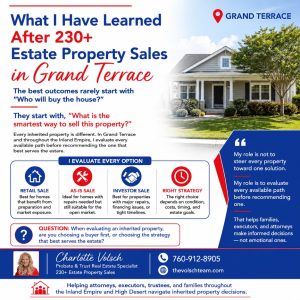
What’s the right way to handle an inherited property—renovate, list, or sell it as-is? I am Charlotte Volsch, an Estate Property Advisor and Probate & Trust Real Estate Specialist helping attorneys, executors, and families make clear, confident decisions when selling inherited homes. I help attorneys, executors, and families navigate inherited property decisions throughout the Inland Empire and High Desert of Southern California, including Apple Valley, Victorville, Hesperia, Rancho Cucamonga, Redlands, Loma Linda, Fontana, and surrounding communities. Over the course of my career, I have completed 774+ real estate transactions across 24 years, including more than 230 probate and trust property sales. For the past 16+ years, I have focused specifically on estate property situations, working alongside probate and trust attorneys, fiduciaries, and their clients to guide each case from evaluation through sale. Many families are unsure what to do with an inherited home—whether to invest in repairs, list it traditionally, or sell it as-is. Without a clear strategy, estates can make costly mistakes such as over-improving a property, underpricing it, selecting the wrong sale method, or facing delays that impact timelines and estate objectives. I help evaluate those decisions early, so attorneys and their clients can move forward with clarity, avoid unnecessary risk, and choose the most appropriate path based on the property and the situation. I work directly with attorneys and their clients to determine the best path forward, whether that involves preparing a property for the retail market or facilitating a direct sale through a network of qualified investors. For properties that require repairs, may not qualify for traditional financing, or are best suited for as-is sale, I provide access to a network of more than 50 active real estate investors. Over the past 12 months, I have closed 68 transactions, reflecting consistent production and experience navigating changing market conditions. I guide each case using the C.A.L.M. Method: C — Clarify We identify what matters now versus what can wait. A — Align We define priorities—legal, financial, and personal. L — Lead I guide each step in the proper order to avoid delays and unnecessary complications. M — Move Forward Clients proceed with clarity and confidence. I am the Broker Owner of The Volsch Team at Volsch Enterprises, Inc., and hold certifications in Probate Real Estate through the National Association of Realtors (NAR) as well as Certified Probate Real Estate Advisor (Probate Biz). If you are an attorney handling probate or trust matters—or assisting a client with an inherited property—I’m available as a resource to help evaluate the best path forward.