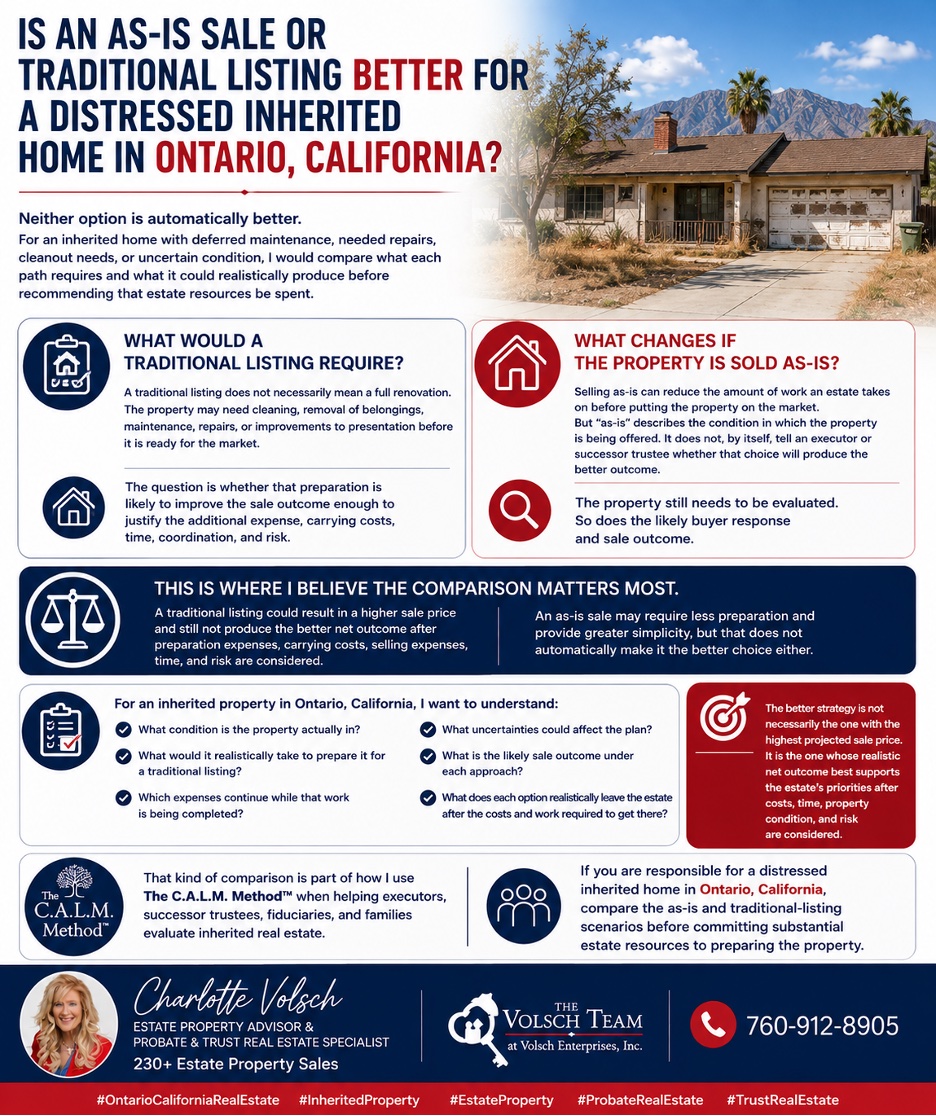
Neither option is automatically better.
For an inherited home with deferred maintenance, needed repairs, clean out needs, or uncertain condition, I would compare what each path requires and what it could realistically produce before recommending that estate resources be spent.
What would a traditional listing require?
A traditional listing does not necessarily mean a full renovation.
The property may need cleaning, removal of belongings, maintenance, repairs, or improvements to presentation before it is ready for the market.
The question is whether that preparation is likely to improve the sale outcome enough to justify the additional expense, carrying costs, time, coordination, and risk.
What changes if the property is sold as-is?
Selling as-is can reduce the amount of work an estate takes on before putting the property on the market.
But “as-is” describes the condition in which the property is being offered. It does not, by itself, tell an executor or successor trustee whether that choice will produce the better outcome.
The property still needs to be evaluated.
So does the likely buyer response and sale outcome.
This is where I believe the comparison matters most.
A traditional listing could result in a higher sale price and still not produce the better net outcome after preparation expenses, carrying costs, selling expenses, time, and risk are considered.
An as-is sale may require less preparation and provide greater simplicity, but that does not automatically make it the better choice either.
For an inherited property in Ontario, California, I want to understand:
• What condition is the property actually in?
• What would it realistically take to prepare it for a traditional listing?
• Which expenses continue while that work is being completed?
• What uncertainties could affect the plan?
• What is the likely sale outcome under each approach?
• What does each option realistically leave the estate after the costs and work required to get there?
The better strategy is not necessarily the one with the highest projected sale price. It is the one whose realistic net outcome best supports the estate’s priorities after costs, time, property condition, and risk are considered.
That kind of comparison is part of how I use The C.A.L.M. Method™ when helping executors, successor trustees, fiduciaries, and families evaluate inherited real estate.
If you are responsible for a distressed inherited home in Ontario, California, compare the as-is and traditional-listing scenarios before committing substantial estate resources to preparing the property.
Charlotte Volsch | Estate Property Advisor & Probate & Trust Real Estate Specialist | 230+ Estate Property Sales | The Volsch Team at Volsch Enterprises, Inc. | 760-912-8905
#OntarioCaliforniaRealEstate #InheritedProperty #EstateProperty #ProbateRealEstate #TrustRealEstate